Insulin Resistance: Early Signs, Tests, and How to Reverse It
By Dr. Chandrashekhar Bhandiwad, MBBS, MD, DM (Endocrinology & Metabolic Health)
Consultant Physician and Panel Member of Medicine and Science, 150.fit
Primary keyword: insulin resistance symptoms · Search intent: informational, problem-aware
A man in his mid-thirties comes to my clinic holding a normal report. Fasting glucose 92 mg/dL. HbA1c 5.4%. His family doctor has told him everything is fine, and on that paper, everything is. He is here because his waist has been quietly expanding for four years, he cannot stay awake after lunch, and his father started insulin at fifty. His report is normal. His metabolism is not. That gap is what this article is about. (The patient is a composite drawn from a pattern I see most weeks, not one identifiable person.)
What is actually going wrong
Insulin is a hormonal signal. After a meal, the pancreatic beta cell releases it to instruct muscle, liver and adipose tissue to take up glucose. In insulin resistance those tissues respond poorly to the signal, so the beta cell compensates by secreting more. The result is hyperinsulinaemia: high insulin holding normal glucose in place.
For years, that compensation works. Glucose stays in range because the beta cell is paying for it. What your blood test shows is the outcome of that struggle, not the struggle itself.
This is why I have become sceptical of assessing metabolic health with fasting glucose alone. A normal value tells you compensation is still holding. It says nothing about what the compensation is costing.
The silent decade
The compensated phase can run ten years or longer before anyone receives a diagnosis. During it, insulin remains high, visceral adiposity accumulates, hepatic fat rises, and in women the ovary responds through a well described pathway into PCOS(now PMOS).
By the time fasting glucose drifts upward, beta-cell function has usually already declined measurably. Most of the story has been written. The window in which things reverse easily has been open, and closing, for a long time.
Clues, not symptoms
Insulin resistance produces no clean symptom, which is exactly why it is missed. It produces a pattern:
- Weight settling centrally, often without much change on the weighing scale
- Marked post-prandial somnolence, particularly after rice or wheat heavy meals
- Persistent craving for refined carbohydrate
- Acanthosis nigricans (dark, velvety skin at the neck, axillae or groin) and skin tags
- Irregular cycles, hirsutism or a PCOS diagnosis
- Weight that will not shift despite real effort
- Reports mentioning raised triglycerides, low HDL cholesterol, or hepatic steatosis on ultrasound
These are associations, not diagnostic criteria. I have seen lean, asymptomatic patients with clearly abnormal insulin dynamics, and patients with half this list whose testing came back unremarkable. The pattern tells you when to look. It does not tell you what you will find.
Clinical pearl: in South Asians, waist beats BMI. A normal BMI with a waist of 96 cm is a metabolic problem. A raised BMI in a heavily muscled man may not be. Measure the waist.
The numbers worth knowing
Waist circumference. Indian cut-offs for abdominal obesity are 90 cm in men and 80 cm in women (Misra et al., consensus statement, 2009). These are considerably lower than European thresholds, and for good reason.
Waist-to-height ratio. Above 0.5 is now used as an alternative marker of abdominal adiposity in Indians. Keep your waist under half your height.
BMI. In January 2025 an Indian expert group revised the national obesity definition, moving away from BMI alone towards a two-stage system (Misra et al., Diabetes Metab Syndr, 2025). Stage 1 is raised adiposity (BMI above 23 kg/m²) without effects on organ function. Stage 2 requires BMI above 23 kg/m² plus excess waist circumference or waist-to-height ratio, together with functional limitation or an obesity-related comorbidity. The direction of travel is clear: fat distribution now matters more than the ratio.
Glucose thresholds. Fasting plasma glucose of 100 to 125 mg/dL is impaired fasting glucose by ADA criteria, and 126 mg/dL or above on two occasions is diabetes. On a 75 g OGTT, a 2-hour value of 140 to 199 mg/dL is impaired glucose tolerance and 200 mg/dL or above is diabetes. HbA1c of 5.7 to 6.4% is prediabetes by ADA criteria, though thresholds vary between guidelines, so check which your laboratory reports against.
The 1-hour value. In March 2024 the International Diabetes Federation issued a position statement recommending the 1-hour post-load glucose, with cut-points of 155 mg/dL for intermediate hyperglycaemia and 209 mg/dL for type 2 diabetes. The evidence that 1-hour glucose predicts progression better than fasting glucose, HbA1c or the 2-hour value is substantial. It is not yet embedded in most Indian laboratory protocols, so you may need to request the extra sample specifically.
Fasting insulin and HOMA-IR. Here I have to be honest about the limits. There is no universally agreed cut-off for either. Published thresholds vary by assay and population, so these should be treated as supportive data, not as stand-alone diagnostic tests. A raised value is a reason to look harder, not a diagnosis in itself.
Screening and initial workup
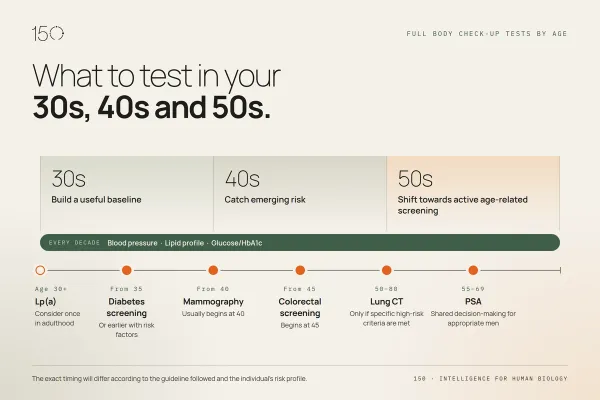
If someone fits the pattern above, this is a reasonable sequence. Who to assess: central adiposity or waist above the Indian cut-off, first-degree relative with type 2 diabetes, PCOS, hepatic steatosis on any scan, dyslipidaemia, acanthosis nigricans, history of gestational diabetes, or established cardiovascular disease.
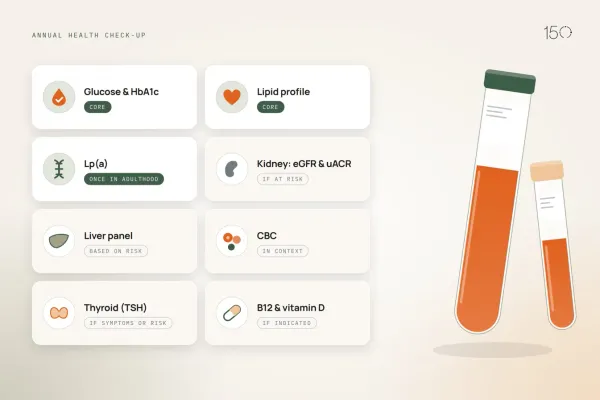
Baseline tests:
- Waist circumference and height, measured rather than estimated
- Fasting plasma glucose and HbA1c
- Fasting lipid profile, with attention to triglycerides and HDL
- ALT and hepatic ultrasound if steatosis is suspected
- Blood pressure
- Fasting insulin, for selected patients where the earlier phase is the clinical question
When to escalate: proceed to a 75 g OGTT (with a 1-hour sample where feasible) when fasting glucose or HbA1c is equivocal, when clinical suspicion is high despite normal fasting tests, or in PCOS. Refer to an endocrinologist when dysglycaemia appears young or in a lean patient, when diabetes is atypical or possibly monogenic, when PCOS is complex, or when transient elastography suggests significant hepatic steatosis.
Why this reads differently in India
The scale is not subtle. The ICMR-INDIAB national survey found diabetes in 11.4% of Indian adults and prediabetes in 15.3%, which translates to roughly 101 million and 136 million people. That second figure is where insulin resistance is the whole story, and where it remains reversible.[1][2].
There is a more specific problem. South Asians develop insulin resistance at lower body weight and younger age than the populations most reference ranges were built on. Yajnik's work on the thin-fat Indian described it early: comparing rural Pune newborns with Southampton newborns, the Indian babies were lighter and shorter but relatively preserved their subcutaneous fat, a body composition the authors argued predisposes to an insulin-resistant state.
The practical consequence for a reader in India is that your BMI can be reassuring and wrong.
What reverses it
This is the part I enjoy telling patients, because the honest answer is optimistic. Insulin resistance responds to intervention better than almost anything else I treat. The main lever is visceral fat. Losing 5 to 10% of body weight produces a disproportionate improvement in insulin sensitivity, and that finding holds across major prevention trials. In the Diabetes Prevention Program, a lifestyle programme targeting 7% weight loss and 150 minutes of weekly activity reduced progression to diabetes by 58%, and metformin also helped. In the Indian Diabetes Prevention Programme, both lifestyle modification and metformin reduced progression from impaired glucose tolerance to diabetes in Asian Indian participants, who were younger, leaner, and more insulin resistant than many Western cohorts.[3][4]
Practical targets:
- Weight. Aim for 5 to 10% of starting body weight, sustained. For a 78 kg man that is 4 to 8 kg, not 20.
- Activity. At least 150 minutes weekly of moderate aerobic activity, plus resistance training twice weekly. Skeletal muscle is where most post-prandial glucose goes, and resistance work protects the muscle mass that South Asians tend to carry less of. A 10-minute walk after dinner measurably blunts the glucose excursion and is the single easiest thing on this list.
- Food. Reduce refined carbohydrate and added sugar; keep protein adequate; raise fibre through pulses, vegetables, and whole grains. The named diet matters far less than sustained reduction.
- Sleep. Aim for 7 hours. Short sleep and chronic psychological stress worsen insulin sensitivity through cortisol and related pathways.
What limits reversibility
Optimism has boundaries, and patients deserve them stated. Reversibility falls with longer duration of dysglycaemia, because beta-cell function declines progressively and some of that loss does not recover. I t also falls with age, strong family history, and polygenic risk.
The realistic framing is this: early insulin resistance with preserved beta-cell function often improves substantially. Established type 2 diabetes of ten years' standing may improve without fully reversing. Both are worth treating. They are not the same conversation.
Medication, and when it is reasonable
Metformin has a defensible role in higher-risk prediabetes, particularly in younger patients, those with higher BMI, and women with prior gestational diabetes, and in PCOS with metabolic features. Newer agents, including GLP-1 receptor agonists are increasingly used where obesity is the dominant driver, but cost and individual suitability matter.
One caution I want to state plainly. Do not start medication on the basis of a raised fasting insulin or HOMA-IR alone. Those indices are not validated for that decision. Medication choices should be based on confirmed glycaemic and cardiometabolic risk.
Tools worth knowing about
Continuous glucose monitoring can reveal post-prandial excursions invisible to fasting tests. It is useful for patient education, but it is not a diagnostic test for diabetes.
ALT and transient elastography (FibroScan) matter because metabolic dysfunction-associated steatotic liver disease(MASLD) travels with insulin resistance and independently predicts progression. A fatty liver mentioned casually on a routine scan deserves follow-up rather than reassurance.
Your six-week plan
- Measure your waist at the level of the umbilicus, standing, at the end of a normal breath. Write the number down. Men, target below 90 cm. Women, below 80 cm.
- Ask for these tests: fasting plasma glucose, HbA1c, fasting lipid profile, ALT. Add fasting insulin if you and your doctor want to see the earlier phase.
- Set one weight target: 5% of your current weight over three months.
- Walk 10 minutes after your two largest meals, starting this week.
- Add two resistance sessions weekly, even bodyweight to begin with.
- Review at six weeks with a repeat waist measurement, not just the weighing scale.
What happened to the man from the beginning
He left with a waist measurement of 97 cm, a number nobody had ever given him, and a request for an OGTT with a 1-hour sample. His fasting glucose came back at 94, entirely normal. His 1-hour value was 178 mg/dL.
Not diabetes. Not even impaired glucose tolerance by the 2-hour criterion. Just a decade of warning he would otherwise have spent unaware, and enough time to do something with it.
Key points
- Insulin resistance precedes diabetes by years, sustained by hyperinsulinaemia while glucose still reads normal
- It presents as a pattern rather than a symptom, so it must be tested for deliberately
- Indian waist cut-offs are 90 cm for men and 80 cm for women, and waist beats BMI in South Asians
- The 1-hour OGTT value (155 mg/dL) detects risk earlier than fasting glucose or HbA1c
- HOMA-IR and fasting insulin have no universal cut-off and should never drive treatment alone
- Reversibility is real but falls with duration and beta-cell decline, so early action matters most
Selected references
- Anjana RM, Unnikrishnan R, Deepa M, et al. Metabolic non-communicable disease health report of India: the ICMR-INDIAB national cross-sectional study (ICMR-INDIAB-17). Lancet Diabetes Endocrinol. 2023;11(7):474. doi:10.1016/S2213-8587(23)00119-5
- Misra A, Chowbey P, Makkar BM, et al. Consensus statement for diagnosis of obesity, abdominal obesity and the metabolic syndrome for Asian Indians. J Assoc Physicians India. 2009.
- Knowler WC, Barrett-Connor E, Fowler SE, et al. Reduction in the incidence of type 2 diabetes with lifestyle intervention or metformin. N Engl J Med. 2002.
- Ramachandran A, Snehalatha C, Mary S, et al. The Indian Diabetes Prevention Programme shows that lifestyle modification and metformin prevent type 2 diabetes in Asian Indian subjects with impaired glucose tolerance (IDPP-1). Diabetologia. 2006.
- Yajnik CS, Fall CHD, Coyaji KJ, et al. Neonatal anthropometry: the thin-fat Indian baby. The Pune Maternal Nutrition Study. Int J Obes Relat Metab Disord. 2003.
- International Diabetes Federation. Position statement on the 1-hour post-load plasma glucose for intermediate hyperglycaemia and type 2 diabetes. 2024.
This article is for education and does not replace individual medical advice. If you are concerned about your metabolic health, please consult a qualified clinician.
Published by YouLab.