Annual Health Check-up: Which Blood Tests Do You Actually Need?
By Dr. Jushitha Chowdary N, MBBS, PGDFM, FDM
Family Physician | Diabetes Care Specialist | Lifestyle & Longevity Medicine, 150.fit
Most people finish an annual health check-up with a long report, a column of green ticks and the reassuring feeling that everything is fine.
But a “normal” report does not necessarily mean that every relevant health risk has been assessed.
At the same time, ordering more and more tests is not automatically better preventive medicine.
The real question is:
Which tests are appropriate for your age, symptoms, family history, medications and risk profile — and will the result actually change what you do next?
That is the principle an annual health check-up should be built around.
One Rule Before You Add Any Test
Before ordering a test, ask:
“If this result is abnormal, what will we do differently?”
If there is no clear answer, the test may add cost, anxiety or incidental findings without improving care.
A useful health check-up is not the one with the largest panel.
It is the one that answers the right clinical questions.
1. How Is Your Metabolic Health?
One of the most important goals of preventive testing is identifying prediabetes, diabetes and cardiometabolic risk before complications develop.
Core Tests
Fasting Blood Glucose
Fasting glucose provides a snapshot of blood glucose after an overnight fast.
It is useful for screening for:
- Prediabetes
- Diabetes
- Changes in glucose regulation over time
However, glucose metabolism is more complex than one fasting value.
HbA1c
HbA1c estimates average glucose exposure over roughly the previous 2–3 months.
It is commonly used alongside fasting glucose for diabetes and prediabetes screening.
HbA1c does have limitations. Certain conditions affecting red-blood-cell turnover, haemoglobin or iron status can alter the result, so it needs to be interpreted in context.
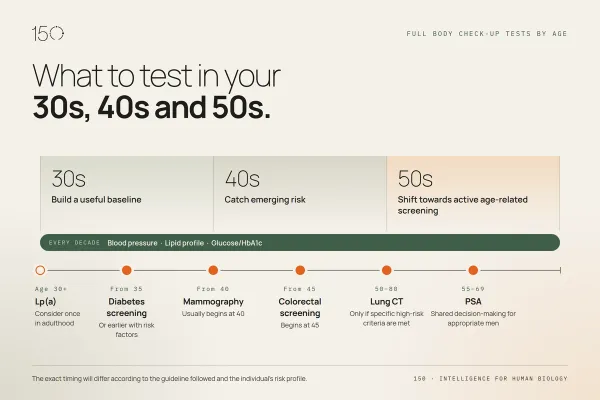
The ADA considers fasting plasma glucose, HbA1c and a 2-hour oral glucose tolerance test appropriate tests for diabetes and prediabetes screening. It recommends routine screening beginning at age 35 for most adults, earlier in people with relevant risk factors, and yearly testing for people who already have prediabetes.
Lipid Profile
A standard lipid panel usually includes:
- Total cholesterol
- LDL cholesterol
- HDL cholesterol
- Triglycerides
These remain fundamental components of cardiovascular risk assessment.
What About Fasting Insulin?
Fasting insulin can provide additional information in selected clinical situations, particularly when evaluating insulin resistance or metabolic health.
However, it is not currently a universally recommended routine screening test for every asymptomatic adult.
It should therefore be ordered when the result will help answer a specific clinical question rather than automatically added to every annual panel.
2. What Is Your Cardiovascular Risk?
A standard cholesterol result does not capture every aspect of cardiovascular risk.
Some additional tests can be useful — but their value depends on the person.
Lipoprotein(a): Usually Worth Checking Once
Lipoprotein(a), or Lp(a), is largely genetically determined and remains relatively stable throughout life.
The 2026 ACC/AHA dyslipidaemia guideline recommends measuring Lp(a) at least once in adulthood. If it is elevated, that information can influence how aggressively other cardiovascular risk factors are managed.
Why it matters
An elevated Lp(a):
- May increase cardiovascular risk
- Is not visible on a routine lipid profile
- Is minimally affected by lifestyle
- May have implications for close family members because of its genetic basis
For most people, repeat testing is not routinely necessary unless there is a specific reason.
ApoB: Useful, but Not Necessary for Everyone
Apolipoprotein B (ApoB) reflects the number of atherogenic lipoprotein particles circulating in the blood.
It can provide useful additional information when LDL cholesterol and particle burden do not tell the same story.
The 2026 ACC/AHA guideline particularly supports ApoB assessment in selected people, including those with:
- Type 2 diabetes
- High triglycerides
- Cardiovascular-kidney-metabolic risk
- Established cardiovascular disease
- Residual risk despite apparently controlled LDL/non-HDL cholesterol
So rather than treating ApoB as a mandatory annual test for everyone:
Use it when it improves cardiovascular risk assessment.
What About hs-CRP?
High-sensitivity C-reactive protein (hs-CRP) measures low levels of systemic inflammation.
It can sometimes help refine cardiovascular risk when the decision about prevention or treatment remains uncertain.
It is not, however, a general-purpose test for finding the cause of inflammation.
An infection, injury or another inflammatory condition can temporarily raise hs-CRP, so an isolated result needs context. Current cardiovascular guidance uses hs-CRP selectively as a risk-enhancing marker rather than as a mandatory annual test for every healthy adult.
3. How Are Your Kidneys Functioning?
Kidney disease can remain silent for a long time.
But more testing is not necessarily required for every healthy person.
The key is identifying who is at increased risk.
Creatinine and eGFR
Serum creatinine is commonly used to estimate kidney filtration through the estimated glomerular filtration rate, or eGFR.
Creatinine is influenced by factors beyond kidney function, including:
- Muscle mass
- Diet
- Certain supplements
- Some medications
So the result should not be interpreted in isolation.
Urine Albumin-to-Creatinine Ratio
The urine albumin-to-creatinine ratio (uACR) can detect small amounts of albumin leaking into the urine.
This can identify kidney damage before serum creatinine changes substantially.
It is particularly important in people at increased risk, including many patients with:
- Diabetes
- Hypertension
- Known kidney disease
- Other relevant risk factors
KDIGO recommends assessing people at risk of chronic kidney disease using both kidney filtration and urine albumin measurements.
Where Does Cystatin C Fit?
Cystatin C provides another way of estimating kidney filtration.
It can be useful when creatinine-based eGFR may be inaccurate or when greater precision is clinically important.
However, it is not necessary to automatically add cystatin C to every healthy person's annual blood panel.
KDIGO recommends creatinine-based eGFR for adults at risk of CKD and supports combined creatinine-cystatin C estimation when cystatin C is available and greater accuracy is needed.
4. How Is Your Liver Doing?
Routine liver testing can provide useful information about liver-cell injury, bile flow and overall liver health.
A typical liver panel may include:
- ALT
- AST
- Alkaline phosphatase
- Bilirubin
- Albumin
ALT and AST
ALT and AST can rise with liver-cell injury.
Common causes include:
- Metabolic fatty liver disease
- Alcohol
- Medications
- Viral hepatitis
- Other liver conditions
AST can also rise because of muscle injury or strenuous exercise.
GGT
GGT can sometimes provide additional information, particularly when interpreting liver or biliary abnormalities or alcohol exposure.
But again, one mildly abnormal liver enzyme is a clue, not a diagnosis.
The pattern, magnitude and trend matter.
5. What Does Your CBC Tell You?
A complete blood count (CBC) is one of the most useful basic investigations when clinically appropriate.
It provides information about:
- Haemoglobin
- Red blood cells
- White blood cells
- Platelets
- Red-cell indices
It can help identify patterns suggesting:
- Anaemia
- Infection
- Certain nutritional deficiencies
- Haematological abnormalities
But the trend can sometimes be as informative as the flag.
A haemoglobin value that remains technically “normal” while steadily declining over several measurements deserves a different conversation from one that has remained stable for years.
6. Do You Need Iron, Vitamin B12 or Vitamin D Testing?
These tests are useful — when there is a reason to order them.
Ferritin and Iron Studies
Ferritin reflects the body's iron stores but can also rise during inflammation.
If iron deficiency or iron overload is suspected, clinicians may interpret ferritin alongside additional markers such as:
- Transferrin saturation
- Serum iron
- Total iron-binding capacity
- CBC
Ferritin should not always be interpreted as a stand-alone result.
Vitamin B12
Vitamin B12 testing may be particularly relevant for:
- Vegetarians and vegans
- People taking metformin long term
- People using certain acid-suppressing medicines
- People with anaemia or neurological symptoms
- People with gastrointestinal conditions affecting absorption
Vitamin D
Vitamin D deficiency is common in many populations, including India.
But that does not mean every asymptomatic adult necessarily needs an annual vitamin D test.
For asymptomatic adults without specific risk factors or clinical indications, evidence supporting universal vitamin D screening remains insufficient.
Testing makes more sense when the result is clinically relevant — for example, because of bone health, symptoms, previous deficiency or other risk factors.
7. Do You Need Thyroid Tests Every Year?
The usual starting test for thyroid function is:
TSH
If TSH is abnormal, free T4 is commonly used to better characterise the thyroid abnormality.
Thyroid antibody testing, such as TPO antibodies, can be useful in selected situations.
But there is insufficient evidence to recommend universal routine thyroid screening in every asymptomatic, nonpregnant adult.
Testing makes more sense when there are:
- Symptoms
- Family history
- Previous thyroid abnormalities
- Autoimmune disease
- Pregnancy-related considerations
- Other clinical risk factors
And free T3 should not automatically be added to routine screening panels simply because it is available.
8. Do You Need Hormone Tests in an Annual Check-up?
Usually not without a clinical question.
Hormones fluctuate with:
- Time of day
- Menstrual cycle
- Age
- Sleep
- Illness
- Medication
- Reproductive stage
So testing them randomly can create more confusion than clarity.
Testosterone
When testosterone deficiency is genuinely suspected, testing is generally performed in the morning, and an unexpectedly low result usually requires confirmation rather than diagnosis from one measurement.
Female Reproductive Hormones
FSH, LH, estradiol and progesterone should be tested when there is an appropriate clinical reason and interpreted according to menstrual-cycle stage, reproductive status and the question being investigated.
A universal “day 21 progesterone” rule does not apply to every woman; timing depends on cycle length and the clinical purpose of testing.
The principle is simple:
Hormones should be ordered to answer a question — not because they are included in a premium package.
“Normal” Does Not Always Mean “Nothing to Discuss”
Laboratory reference ranges are useful.
But they are not the same thing as an individualised assessment of risk.
A result can be technically inside the laboratory range while still being relevant because of:
- A strong family history
- Symptoms
- Other abnormal markers
- Medication use
- A consistent trend over time
Equally important, a value just outside a reference range does not automatically mean disease.
Look at Trends, Not Just Flags
When possible, compare results over time.
Ask:
- Has the value been stable?
- Is it steadily increasing?
- Is it steadily declining?
- Did anything change between tests?
- Was the same laboratory method used?
- Is the change large enough to be clinically meaningful?
A single measurement is a snapshot.
A trend provides context.
But the number of repeat tests and the interval between them should depend on the test and the clinical situation.
Which Tests Should Be Done Every Year?
There is no universal blood-test panel that every healthy adult needs once a year.
Frequency should depend on age, risk and previous results.
A more useful framework is:
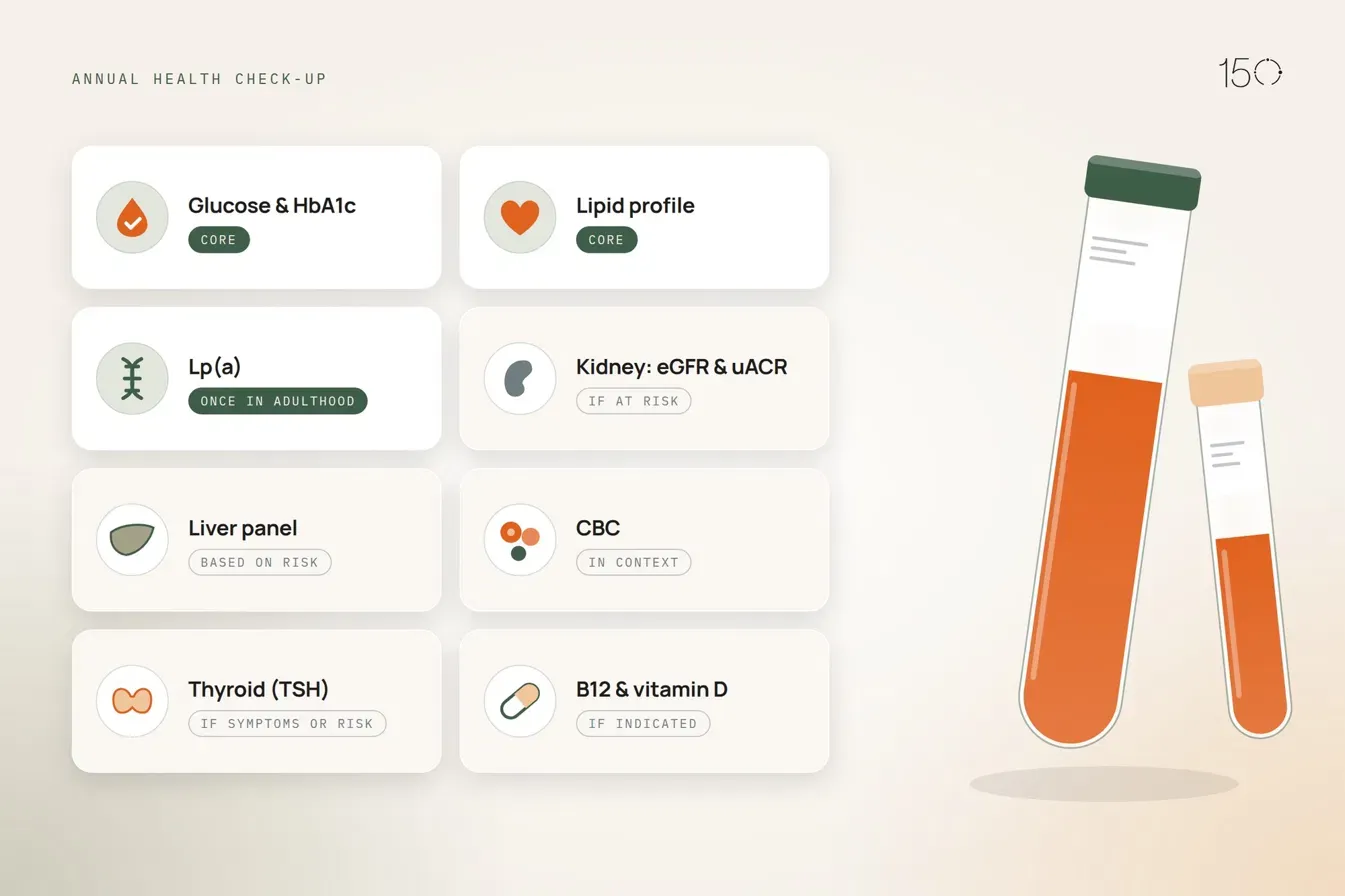
| Test / Assessment | Typical Approach |
|---|---|
| Blood pressure | Regular assessment |
| Fasting glucose / HbA1c | Based on age and diabetes risk; yearly if prediabetes |
| Lipid profile | Periodically according to age and cardiovascular risk |
| Lp(a) | At least once in adulthood |
| ApoB | Selectively when it refines cardiovascular risk |
| CBC | Based on clinical context and individual risk |
| Creatinine / eGFR | Particularly important with kidney-risk factors |
| Urine ACR | Important in people at risk of kidney disease |
| Cystatin C | Selectively when creatinine-based eGFR may be insufficient |
| Liver tests | Based on risk, medications and clinical context |
| TSH | Risk- or symptom-based rather than automatically yearly for everyone |
| Vitamin B12 | Risk- or symptom-based |
| Vitamin D | Risk- or indication-based |
| Ferritin / iron studies | When deficiency, overload or another relevant condition is suspected |
| Hormone testing | Only when there is a specific clinical indication |
For example, the ADA recommends at least 3-year intervals for diabetes screening after a normal result in otherwise lower-risk adults, while people with prediabetes should generally be tested annually.
Similarly, the 2026 ACC/AHA dyslipidaemia guideline supports adult lipid screening beginning early in adulthood, but does not imply that every advanced lipid marker needs annual repetition in every person.
How to Prepare for Your Blood Tests
Preparation depends on what is actually being tested.
Not every blood test requires fasting.
If Your Test Requires Fasting
Follow the laboratory or physician's instructions. Avoid extending the fast substantially beyond what is requested.
Water is generally permitted unless you have specifically been told otherwise.
Avoid Unusually Hard Exercise Before Certain Tests
A strenuous workout can temporarily influence markers including:
- AST
- Creatinine
- Creatine kinase
If the purpose is to establish your usual baseline, avoid an unusually hard training session immediately beforehand.
Tell Your Clinician About Supplements
This is especially important for biotin, which is commonly found in hair, skin and nail supplements.
High-dose biotin can interfere with some laboratory assays, including certain thyroid and cardiac tests.
Whether and how long it should be stopped depends on the dose and laboratory assay, so follow your clinician or laboratory's instructions.
Stay Normally Hydrated
Dehydration can alter the concentration of several blood and urine measurements.
Aim to arrive normally hydrated rather than deliberately over- or under-drinking.
Timing Can Matter
Some tests vary by time of day.
Examples include certain:
- Hormones
- Iron measurements
- Cortisol-related tests
Where serial measurements are being compared, similar conditions can improve interpretability.
Do Not Ignore Recent Illness
Acute infection or inflammation can temporarily alter several blood markers, particularly inflammatory markers such as hs-CRP.
If the check-up is purely routine and you have recently been ill, your physician may advise waiting before testing selected markers.
The Report Is the Starting Point, Not the Deliverable

The purpose of an annual health check-up is not to generate a thicker PDF.
It is to make better decisions.
A useful result should lead to one of three things:
1. Reassurance
No meaningful abnormality was found, and existing habits can continue.
2. Action
Something needs to change — nutrition, exercise, sleep, medication or another aspect of care.
3. Follow-up
A finding needs confirmation, additional investigation or monitoring over time.
The most useful preventive-health cycle is:
Measure → Interpret → Act → Reassess
Without interpretation and action, testing can easily become data collection rather than preventive medicine.
The best annual health check-up is not the one with the most tests.
It is the one built around the right questions.
What risks matter for you?
Which tests can detect those risks reliably?
What would change if the result were abnormal?
And what does the trend show over time?
More testing is not automatically more prevention.
Better-matched testing is.
A blood panel has done its job only when the information is correctly interpreted and leads to an appropriate next step.
Medical Disclaimer
This article is for general education and is not individual medical advice. Appropriate screening tests and testing frequency vary according to age, sex, symptoms, medical history, family history, medications and individual risk factors. Discuss your preventive-health plan with a qualified physician.
References & Further Reading
- American Diabetes Association Professional Practice Committee. Standards of Care in Diabetes—2026: Diagnosis and Classification of Diabetes.
- ACC/AHA Multisociety Guideline on the Management of Dyslipidemia. 2026.
- KDIGO. 2024 Clinical Practice Guideline for the Evaluation and Management of Chronic Kidney Disease.
- US Preventive Services Task Force. Vitamin D Deficiency in Adults: Screening.
- US Preventive Services Task Force. Thyroid Dysfunction: Screening.