How Much Protein Do You Need Per Day? ICMR Guidelines for Indians
By Ruchika, M.Sc. Applied Nutrition, ICMR–NIN
Nutrition, Metabolic Health & Diet, 150.fit
Protein has become one of the loudest words in Indian nutrition — protein atta, protein biscuits, protein shakes, protein water.
But somewhere in the noise, a much simpler question gets lost:
How much protein do you actually need every day?
For Indians, there is a clear starting point. The Indian Council of Medical Research, through the National Institute of Nutrition, publishes protein requirements designed for Indian populations and dietary patterns.
But knowing the number is only half the story.
How much protein you eat matters. Where that protein comes from matters too.
How Much Protein Do You Need Per Day?
According to the ICMR-NIN 2020 recommendations, the Recommended Dietary Allowance (RDA) for protein in healthy adults is:
0.83 g of protein per kilogram of body weight per day
The Estimated Average Requirement (EAR) is 0.66 g/kg/day.
The distinction is useful:
- EAR: Estimated to meet the requirements of about half of healthy people in a population.
- RDA: Set higher to meet the needs of nearly all healthy individuals.
The RDA is therefore a useful daily benchmark, rather than an upper limit on protein intake.
Daily Protein Requirement by Body Weight
A simple starting calculation is:
Body weight in kg × 0.83 = approximate protein requirement per day
| Body Weight | Approx. Daily Protein |
|---|---|
| 50 kg | 42 g |
| 55 kg | 46 g |
| 60 kg | 50 g |
| 65 kg | 54 g |
| 70 kg | 58 g |
| 80 kg | 66 g |
| 90 kg | 75 g |
For example, a person weighing 70 kg would require approximately 58 g of protein per day based on the ICMR recommendation.
Individual requirements may differ depending on:
- Age
- Physical activity
- Pregnancy and lactation
- Illness or recovery
- Calorie restriction
- Training goals
- Medical conditions
Protein Quantity Is Only Half the Story
There is an important condition attached to the 0.83 g/kg recommendation.
It assumes the diet contains good-quality protein.
ICMR also notes that predominantly cereal-based diets may require a higher total protein intake because the protein quality is lower.
This matters in Indian diets because a substantial amount of protein may come incidentally from foods such as:
- Rice
- Wheat
- Roti
- Millet
- Other cereals
These foods contribute protein, but they should not be expected to do all the work.
A better approach is to include a variety of protein sources such as:
- Dal and pulses
- Soya
- Tofu
- Milk and curd
- Paneer
- Eggs
- Fish
- Chicken
- Nuts and seeds
The goal is not simply:
“Did I reach my protein number?”
It is also:
“Where did those grams of protein come from?”
Why Does Protein Quality Matter?
Protein is made up of amino acids.
Nine of these are considered essential amino acids, meaning the body cannot produce enough of them on its own and must obtain them through food.
Different foods provide different amino-acid profiles.
Cereals
Rice, wheat, jowar and bajra contain protein but tend to be relatively lower in lysine.
Pulses
Dal, rajma, chana and other pulses provide more lysine but tend to be relatively lower in amino acids such as methionine.
This is one reason traditional Indian combinations work well:
- Dal + rice
- Rajma + roti
- Idli + sambar
- Khichdi
These foods complement each other across the overall diet.
What Is DIAAS?
One method used to assess protein quality is the Digestible Indispensable Amino Acid Score (DIAAS).
It looks at:
- The essential amino acids provided by a food
- How well those amino acids are digested and absorbed
The source article includes the following approximate comparison:
| Protein Source | Approx. DIAAS |
|---|---|
| Milk and dairy | 1.1–1.4 |
| Egg | 1.13 |
| Whey protein isolate | 1.09 |
| Tofu | 0.97 |
| Soya | ~0.90 |
| Moong dal | ~0.72 |
| Chana, rajma, masoor | ~0.65–0.72 |
| Cooked rice | ~0.60 |
| Wheat and many grains | Below 0.75 |
These figures should be treated as approximate because values can vary with food processing, preparation and methodology.
The practical takeaway is simpler:
Do not depend only on cereals for your daily protein.
Build variety into the day.
Do Vegetarians Need to Combine Proteins at Every Meal?
No.
You do not need to perfectly pair complementary proteins at every individual meal.
The body maintains an amino-acid pool and uses amino acids consumed across the day.
So if your overall diet contains a sensible mix of:
- Cereals
- Pulses
- Dairy
- Soya
- Nuts and seeds
- Eggs, if consumed
you do not need to calculate amino-acid combinations every time you eat.
The overall dietary pattern across the day matters more than perfect pairing at each meal.
Do You Need More Than 0.83 g/kg of Protein?
For some people, yes.
The ICMR figure is designed as a general recommendation for healthy adults.
Protein requirements can increase in certain situations.
Older Adults
Ageing muscle becomes less responsive to the same amount of protein.
Maintaining muscle becomes increasingly important for:
- Strength
- Mobility
- Balance
- Fall prevention
- Recovery
- Independence
Older adults may therefore benefit from more attention to both total protein intake and resistance exercise.
People Who Strength Train
People who regularly perform resistance training often consume more protein than the basic RDA.
Higher intakes may support:
- Muscle repair
- Training adaptation
- Muscle maintenance
- Muscle growth
However, the appropriate intake depends on body weight, training volume, total diet and goals.
Pregnancy, Lactation and Recovery
Protein needs can also increase during:
- Pregnancy
- Lactation
- Recovery from illness
- Major physical stress
- Certain periods of energy restriction
These situations are better individualised rather than managed with one generic protein number.
Do You Really Need 1.6 g of Protein per Kilogram?
You may frequently hear:
“You need 1.6 g/kg of protein.”
That number is commonly discussed in resistance-training research.
But it should not be treated as a universal requirement for everyone.
Someone training intensively for muscle gain has very different needs from someone who is moderately active and simply wants to maintain good health.
A more practical approach is:
- Meet your baseline requirement consistently
- Ensure the protein comes from good-quality sources
- Adjust intake according to age, activity, training and individual needs
The source article also notes that the commonly cited 1.6 g/kg figure comes from resistance-training research and should not automatically be treated as a rigid target for every adult.
Is More Protein Always Better?
No.
Protein has diminishing returns.
Eating more protein does not automatically mean building more muscle.
Muscle gain also requires:
- Resistance training
- Adequate energy intake
- Recovery
- Sleep
Protein also provides approximately 4 kcal per gram, so excessive intake can still contribute to excess energy consumption.
A diet can be high in protein and still be poorly balanced if it is:
- Low in fibre
- Low in vegetables
- Low in fruit
- High in refined carbohydrates
- High in sodium
- High in ultra-processed foods
Protein is one part of a healthy diet, not the whole diet.
Where Do Indian Diets Commonly Fall Short on Protein?
For many people, the protein gap appears in two places.
1. Breakfast
Common Indian breakfasts may be relatively low in protein when eaten alone:
- Poha
- Upma
- Plain idli
- Paratha
- Toast
- Cereal
Breakfast is therefore often the easiest meal to improve.
Simple upgrades
- Idli + sambar + curd
- Poha + peas + curd
- Moong dal chilla + curd
- Besan chilla
- Eggs + roti
- Paneer or tofu bhurji
- Milk or hung curd
2. Snacks
Protein often disappears between meals.
Common choices such as:
- Chai + biscuits
- Namkeen
- Fruit alone
may contribute very little protein.
Consider replacing some of these with:
- Roasted chana
- Curd
- Milk
- Buttermilk
- Sprouts
- Nuts
- Eggs
- Paneer
- Chickpeas
The original article identifies breakfast and between-meal eating as two of the most common protein gaps in Indian diets.
Which Foods Give You More Protein for Their Calories?
Protein density can be useful if you are trying to increase protein without substantially increasing total calorie intake.
| Food | Approx. Protein per 100 kcal |
|---|---|
| Egg white | ~21 g |
| Chicken breast | ~18 g |
| Lean fish | ~17 g |
| Soya chunks | ~14 g |
| Low-fat / hung curd | ~9–11 g |
| Whole egg | ~9 g |
| Full-fat paneer | ~7 g |
| Cooked dal, rajma, chana | ~6 g |
| Roti | ~3 g |
These are approximate figures and will vary according to preparation, brand and recipe.
Do You Need Protein Powder?
Not necessarily.
Protein powder is best thought of as a convenient source of concentrated protein.
It may be useful if:
- You struggle to meet your protein requirement through food
- You have limited time
- You train regularly
- You need something portable
- A full meal is inconvenient
But protein powder is not inherently better than food.
Food-first options include:
- Eggs
- Curd
- Milk
- Soya
- Tofu
- Paneer
- Dal
- Beans
- Fish
- Chicken
The original article also references Indian research raising concerns about labelling and quality in some protein supplements sold in India. Those specific percentages should be checked against the original studies before publication.
A practical rule:
Food first where possible. Supplements when useful.
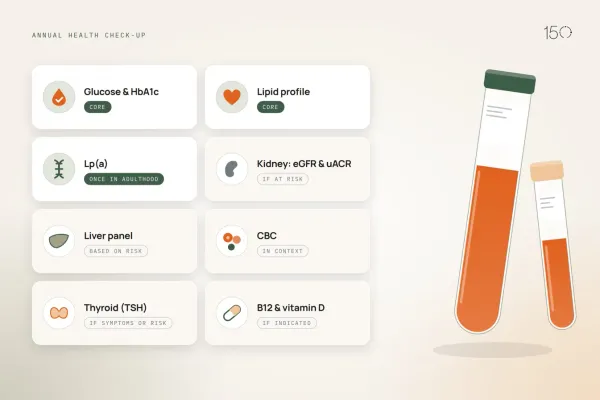
Can Eating More Protein Affect Kidney Blood Tests?
It can affect some laboratory values, which is why results should always be interpreted in context.
Urea
Urea is produced when the body metabolises protein.
Eating more protein can therefore increase blood urea.
Creatinine
Creatinine can be influenced by:
- Muscle mass
- Exercise
- Creatine supplementation
- Other individual factors
People with more muscle may naturally have higher creatinine levels.
eGFR
Many standard eGFR calculations use blood creatinine.
Because creatinine can be influenced by factors other than kidney filtration, clinicians may sometimes use additional tests such as cystatin C when the creatinine-based estimate does not fit the overall clinical picture.
The source article also emphasises that studies examining higher protein intake and kidney function generally refer to people without established kidney disease.
If you have:
- Chronic kidney disease
- Diabetes
- High blood pressure
- A family history of kidney disease
it is sensible to understand your kidney function before making large changes to protein intake.
How to Check Whether You Are Eating Enough Protein
You do not need to start by tracking every calorie.
Take one ordinary day and write down everything you eat.
Then identify your main protein sources:
- Dal
- Rajma
- Chana
- Soya
- Tofu
- Dairy
- Eggs
- Fish
- Chicken
- Meat
- Nuts
- Seeds
Then ask yourself three questions:
1. Does each main meal contain a meaningful protein source?
2. Where is most of my protein coming from?
Is it mostly from rice and wheat, or from more concentrated sources such as pulses, dairy, eggs and soya?
3. Does my intake roughly reach my body-weight target?
Calculate:
Body weight × 0.83
and compare that figure with your usual day.
This does not need to be exact.
The goal is to understand whether you have:
too little total protein
or
enough food overall, but not enough meaningful protein sources.
Protein requirements do not need to be complicated.
For most healthy Indian adults:
0.83 g of protein per kilogram of body weight per day
is a useful starting point.
But the number should not be viewed in isolation.
Also ask:
Where is my protein coming from?
Does every main meal contain a meaningful protein source?
Am I relying too heavily on cereals?
Does my intake match my age, activity and health goals?
The aim is not to consume the highest possible amount of protein.
It is to consistently consume enough good-quality protein as part of an overall balanced diet.
References & Further Reading
- ICMR–National Institute of Nutrition. Nutrient Requirements for Indians: Recommended Dietary Allowances (RDA) and Estimated Average Requirements (EAR). 2020.
- ICMR–National Institute of Nutrition. Dietary Guidelines for Indians. 2024.
- FAO. Dietary Protein Quality Evaluation in Human Nutrition. FAO Food and Nutrition Paper 92. 2013.
- Mathai JK, Liu Y, Stein HH. Values for Digestible Indispensable Amino Acid Scores (DIAAS) for selected dairy and plant proteins. British Journal of Nutrition. 2017.
- Morton RW, et al. Protein supplementation and resistance training-induced gains in muscle mass and strength: systematic review and meta-analysis. British Journal of Sports Medicine. 2018.
- Devries MC, et al. Changes in kidney function do not differ between healthy adults consuming higher- compared with lower- or normal-protein diets. Journal of Nutrition. 2018.
- Indian Food Composition Tables (IFCT). National Institute of Nutrition. 2017.
- World Health Organization. Healthy Diet.
- FAO & WHO. What Are Healthy Diets? 2024.