Biological Age Tests: What Do They Measure and How Accurate Are They?
By Dr. Ande Sriman, M.B.B.S., M.D., Fellowship in Diabetes Mellitus
Consultant Physician and Panel Member of Medicine and Science, 150.fit
Patients sometimes come to me excited—or worried—about a number on a biological age report.
“My chronological age is 48, but my biological age says 39. Does that mean I’m really younger?” Or the opposite: “My biological age is higher than my actual age. Should I be concerned?”
Biological age tests have become increasingly visible in longevity and preventive health. Their appeal is easy to understand: instead of simply telling you how many years you have lived, they promise to provide information about how your body may be ageing. But ageing is enormously complex. Reducing it to a single number can be useful only if we understand what was measured, how the number was calculated, and what that number can—and cannot—tell us.
Biological Age vs Chronological Age: What Is the Difference?
Your chronological age is simply the amount of time that has passed since you were born.
Your biological age is an attempt to describe age-related changes in your body's biological systems.
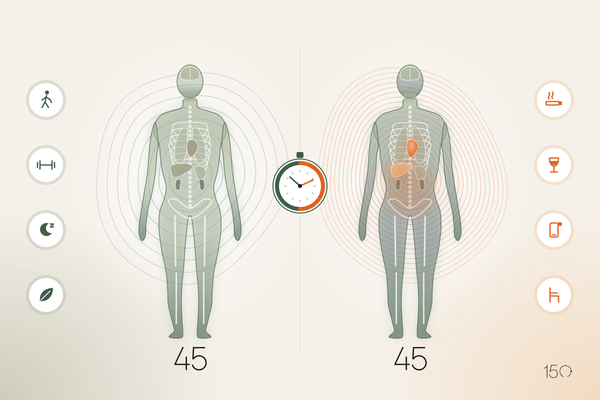
Two people who are both 50 may have very different cardiovascular fitness, metabolic health, muscle function, inflammation, vascular health and disease risk.That is the idea biological-age measurements are trying to capture.However, there is an important limitation:
There is currently no universally accepted single measure of biological age. Different biological-age tests measure different processes and may therefore produce different answers for the same person. Recent reviews emphasise that ageing clocks should be viewed as distinct ways of measuring aspects of biological ageing rather than interchangeable measurements of one “true” biological age.
How Is Biological Age Measured?
There are several approaches to estimating biological age. The most common include DNA methylation-based epigenetic clocks, clinical biomarker models, and telomere measurements.
1. Epigenetic Clocks and DNA Methylation
One of the most extensively studied approaches uses DNA methylation. DNA methylation refers to chemical modifications attached to DNA that can influence how genes are regulated without altering the underlying DNA sequence. Patterns of methylation at particular locations in the genome change with age. Researchers have used these patterns to build mathematical models—commonly called epigenetic clocks—that estimate age-related biological characteristics from a blood or tissue sample.Epigenetic clocks are among the most researched biological-age measures, but they should not be described as a definitive gold standard. Different clocks were built for different purposes.
First-Generation Epigenetic Clocks
Early models such as the Horvath and Hannum clocks were primarily designed to estimate chronological age from DNA methylation patterns.
They demonstrated that methylation patterns can predict chronological age remarkably well.
But predicting someone's calendar age is not necessarily the same thing as measuring their health or rate of ageing.
Second-Generation Epigenetic Clocks
Later models were designed to capture outcomes more closely associated with health and longevity.
Examples include PhenoAge and GrimAge.
These models incorporate biological information associated with morbidity or mortality rather than focusing exclusively on predicting chronological age. Research suggests that some second-generation clocks perform better than earlier clocks in predicting certain disease outcomes and mortality.
Pace-of-Ageing Measures
Another approach asks a slightly different question:
Rather than “How old does your biology appear?”, it asks “How quickly are age-related changes occurring?”
DunedinPACE is an example.
It was developed using longitudinal measurements of changes across multiple organ systems and produces an estimate related to the pace of ageing, rather than simply returning another version of chronological age.
That distinction is important when interpreting results.
2. Telomere Length
Telomeres are repetitive DNA-protein structures at the ends of chromosomes that help protect chromosome integrity.
Telomeres tend to become shorter with age, although the relationship is affected by cell type, genetics, biological processes and measurement methods.
This made telomere length an early candidate for estimating biological ageing.However, measuring telomere length alone provides only a limited picture.A large meta-analysis involving more than 740,000 individuals found that telomere length was associated with chronological age, but the relationship was relatively modest and influenced by factors including tissue type and testing method. Current evidence therefore suggests that telomere length may provide useful information as part of a broader assessment, but it should not be interpreted as a standalone measurement of a person's overall biological age.
3. Clinical Biomarker-Based Biological Age Tests
Not every biological-age model requires genomic testing.
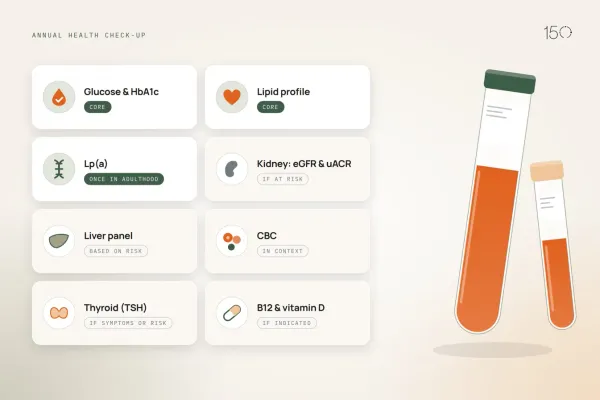
Some models use familiar clinical measurements such as:
- Fasting glucose
- HbA1c
- Lipid measures
- Inflammatory markers
- Liver and kidney markers
- Blood pressure
- Body composition
- Physical-performance measures
Algorithms combine several variables to estimate how a person's physiological profile compares with patterns associated with ageing.
These approaches can be useful because many of the underlying measurements already have recognised clinical meaning.
But again, the resulting biological-age number is an estimate generated by a particular model, not a direct measurement of ageing itself.
Why Two Biological Age Tests Can Give Different Results
Imagine taking two biological-age tests during the same month. One reports a biological age of 42. Another reports 48. Which one is correct?Potentially, neither should be interpreted as the single “true” answer.
There are several reasons results can differ.
Different Tests Measure Different Things
A DNA methylation clock, a biomarker-based algorithm and a telomere test are analysing different biological processes.
Even different epigenetic clocks can capture substantially different molecular pathways and health outcomes. Research comparing multiple clocks shows meaningful variation in what each one predicts.
Sample Type Can Matter
DNA obtained from blood, saliva or another tissue does not necessarily produce identical ageing estimates.
The composition of the sample and the biological processes represented can influence results.
Laboratory and Analytical Methods Can Matter
How samples are collected, processed and analysed can also influence measurements.Encouragingly, newer research suggests that many modern epigenetic clocks show good technical reproducibility when the same sample is repeatedly analysed. But that does not mean every biological-age measurement is perfectly stable.A 2026 study assessing 18 epigenetic ageing biomarkers found that although technical reproducibility was generally strong, short-term biological reliability was considerably more variable across several clocks.
Can Stress, Sleep or Exercise Change Your Biological Age Result?
Possibly—but this area needs careful interpretation.Ageing biomarkers can be influenced by biological and environmental factors, including stress, diet and exercise. Researchers are actively studying how lifestyle exposures affect epigenetic-age measurements.Recent evidence also suggests that some epigenetic clocks can show short-term biological variability related to factors such as meals, stress and environmental exposures.That means a small short-term movement in your score should not automatically be interpreted as:
“I suddenly aged three years.”
The measurement may reflect a combination of long-term ageing processes, short-term physiology and characteristics of the particular test.
So, How Accurate Are Biological Age Tests?
This is where the word “accuracy” becomes tricky.To know whether something is accurate, we ordinarily compare it with a known true value.For blood glucose, for example, laboratories can compare measurements with validated reference standards.For biological age, there is currently no universally accepted true biological-age value against which every test can be calibrated.
Scientists can instead ask whether a particular ageing measure:
- Reproduces reliably
- Predicts mortality
- Predicts age-related disease
- Relates to physical or cognitive function
- Changes meaningfully over time
- Performs consistently across different populations
Some clocks perform well on particular outcomes while others perform better on different ones. This is why asking “Which biological age test is the most accurate?” does not currently have one simple answer.
Can You Use Biological Age to Track Longevity?
Potentially—but with caution.A biological-age measure may be more useful as one part of longitudinal health monitoring than as an isolated score.Instead of focusing on whether your report says 38, 41 or 44, the more clinically useful questions may be:
What is driving the result?
Are established health markers improving?
Is cardiovascular fitness improving?
Is metabolic health improving?
Are strength and body composition improving?
Are cardiovascular risk factors moving in the right direction?
And importantly: Does a change in biological-age score correspond with meaningful improvements in health?
How to Interpret a Biological Age Test
If you decide to use biological-age testing, I recommend keeping three principles in mind.
1. Don't Treat One Number as a Diagnosis
A biological-age result does not diagnose disease.
A score higher than your chronological age does not automatically mean that you are unhealthy, and a younger score does not mean that you are protected from cardiovascular disease, diabetes, cancer or other conditions.
2. Look at Trends, Not Just One Result
If repeat testing is clinically appropriate, comparing measurements over time may provide more context than obsessing over a single result.Where possible, use the same testing methodology and laboratory platform, because switching between different clocks may make comparisons difficult.Follow the sample-collection instructions provided by the laboratory and discuss major illness or other factors that could affect interpretation with your clinician.
3. Connect the Result to Clinically Meaningful Health Measures
A biological-age result becomes more useful when it is interpreted alongside information such as: blood pressure + metabolic health + cardiovascular risk + body composition + fitness + sleep + lifestyle + medical history The goal should not simply be to make a biological-age number smaller. The goal is to improve health and function.
The Precision Medicine Approach to Biological Age
Precision medicine does not depend on one score.It brings together multiple sources of information to understand an individual's health in context.A biological-age test can contribute one signal.But that signal should sit alongside established clinical biomarkers, physical function, medical history, genetics, lifestyle and changes observed over time. In other words:
The biological-age number is not the destination.
What matters is understanding what the underlying data are telling us about health—and whether there is something meaningful we can act on.
References & Context
- NIH Promise of Precision Medicine: National Institutes of Health. The Promise of Precision Medicine. https://www.nih.gov/about-nih/what-we-do/nih-turning-discovery-into-health/promise-precision-medicine
- AI-Driven Biomarker Discovery: AI-driven biomarker discovery: enhancing precision in cancer diagnosis and prognosis. PMC / Nature Publishing Group (2025).
- Machine Learning in Precision Health: AI and Precision Medicine: Paving the Way for Future Treatment. Preprints / Canadian Science Publishing (2024).
- NIH All of Us & Predictive Risk Stratification: Precision Medicine, AI, and the Future of Personalized Health Care. PMC / NIH All of Us Research Program.